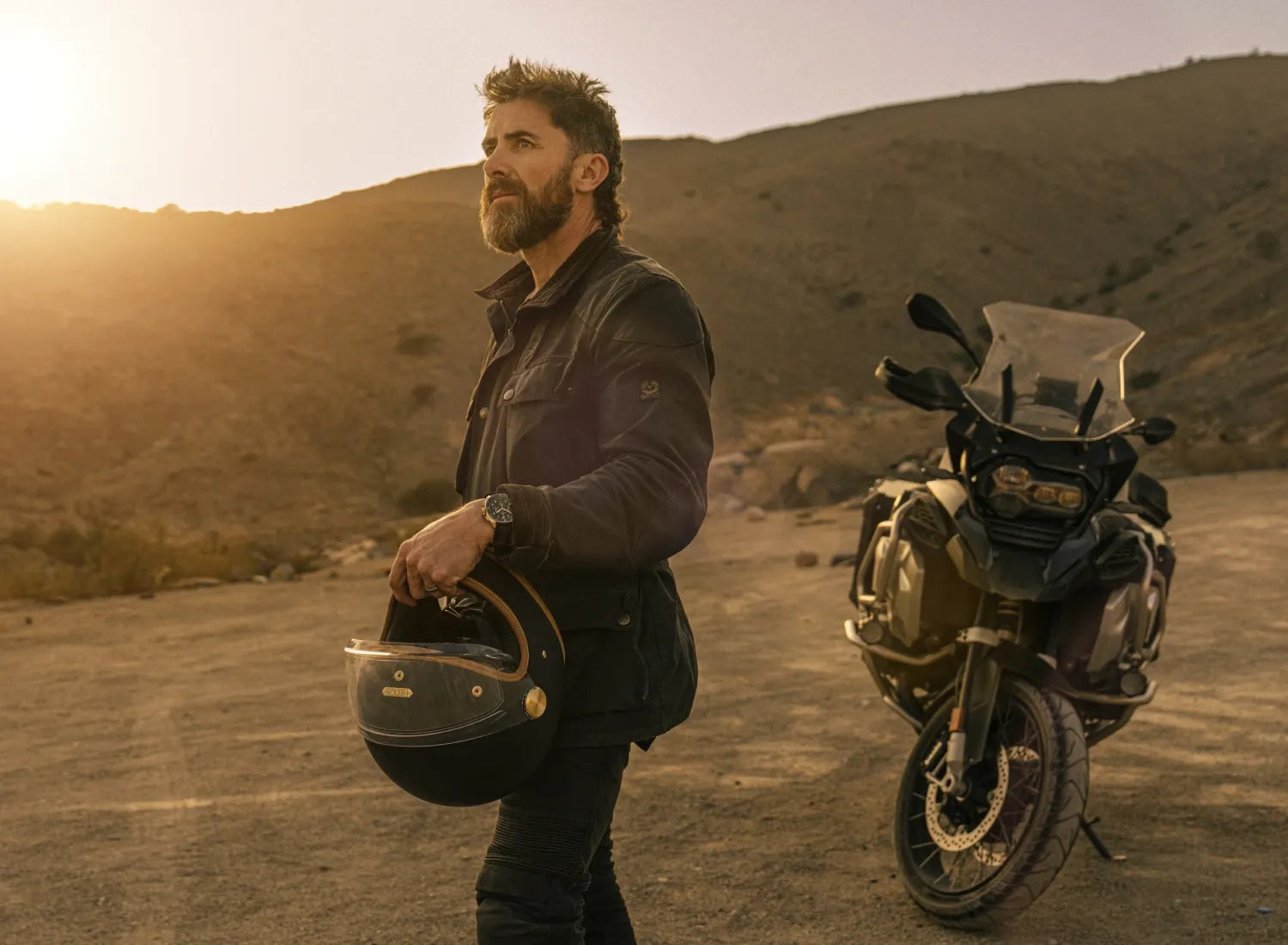
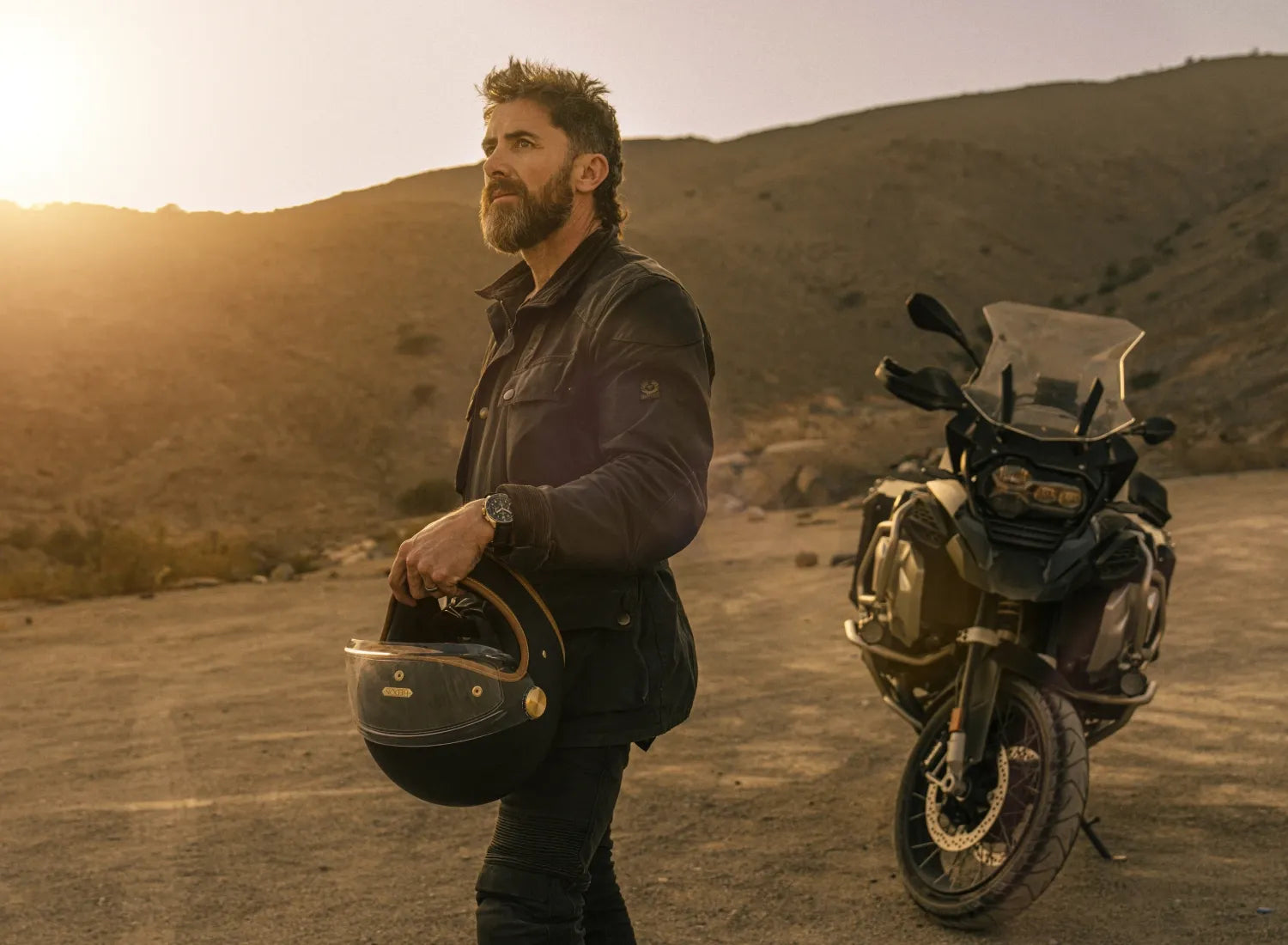
Testing the Supermarine Full Ceramic Deep Blue in Iceland, and reflecting on a life spent on and under the water.
Aldo Kane is a world-record-breaking adventurer and former Royal Marines Commando. After 10 years in the Marines, he now works on major TV and film productions in some of the world’s most demanding environments.
For this mission, Aldo travelled to Iceland to put the Supermarine Full Ceramic Deep Blue to the test, diving in freezing glacial lakes and crossing the country’s vast ice fields.

1. Where did your relationship with the ocean begin?
I grew up on the west coast of Scotland, so the sea was always close. We spent plenty of family holidays exploring the coast, but it wasn’t until I joined the Royal Marines that I got my first proper taste of life at sea.
At nineteen, I deployed on an exercise called Ocean Wave. It was a full Commando deployment with the fleet, and I spent around seven months on HMS Fearless, travelling from Portsmouth to the Far East. That was the first time I’d looked in every direction and seen nothing but sea, right out to the horizon. Growing up beside the water is one thing. Being out there with no land in sight gives you a very different sense of its scale.

2. Across your expeditions, which encounter with the sea has stayed with you most?
I’ve completed many ocean expeditions, most recently for the Apple TV series The Wild Ones and for Disney and National Geographic’s OceanXplorers. But the expedition that has stayed with me most was our Team Essence mainland-to-mainland Atlantic row. We spent 50 days, 10 hours and 36 minutes rowing from Portugal to Venezuela and into the Guinness World Records.
It was properly life-changing. Fifty days in a rowing boat gives you a lot of time to think, but you still have a job to do and a team depending on you. You have to keep turning up for your shift, whatever sort of day you’re having.
I’ve also made several submersible dives to 1,000 metres. That’s a completely different experience, looking out into a part of the ocean very few people get to see. The row stays with me for what it demanded of us. Those dives stay with me for the sheer wonder of being down there.

3. How has your understanding of the ocean changed as you’ve spent more time around it?
When I was younger and at sea, I thought of the ocean as vast, separate from everyday life and generally in good order. The more time I’ve spent on it and underneath it, the more I’ve realised how connected and fragile it is.
From the surface, you can look out at an empty horizon and assume everything is fine. You don’t see what’s happening beneath you. Spending time underwater has made me much more aware of how little that view from the deck tells you. I still have the same respect for the power of the sea, but I now think much more about what it needs from us.
4. Can you describe a time at sea when you had to change your plan?
When we were rowing across the Atlantic, a rogue wave capsized us at night. It was one of the most terrifying experiences I’ve ever had to deal with. There was no immediate rescue coming and no help just over the horizon. It became clear very quickly that getting out of that situation would be down to us.
The ordeal lasted about six hours. Our focus had to narrow to dealing with what was in front of us. The crossing and the record could wait; we had to get through that situation first.
Afterwards, our plans and attitudes had changed. It’s a hard reminder that a plan is only useful while it fits the conditions. You need to be able to let go of what you expected to happen and deal with what is actually happening. At sea, hanging on to the original plan for the sake of it can cost you.

5. Coming to Iceland after expeditions elsewhere, what felt different?
I’ve filmed in Iceland many times. Before this trip, I’d been there for the National Geographic and Disney series Welcome to Earth with Will Smith. What keeps bringing people back is how raw and wild the place is. You’ve got volcanoes, mountains, rivers, glaciers and black sand beaches, all on one island.
What struck me on this visit was how visible the changes in the landscape are. You don’t have to travel far to see the ground left behind where glaciers once stood. It makes the retreat of the ice much easier to grasp than a figure on a page.
Coming back to a place matters. You’re looking at it with some memory of what was there before. Iceland is still spectacular, but it also makes you stop and think about how quickly a landscape can change.
6. Take us through the moments before entering the freezing water.
Iceland has some of the most spectacular diving I’ve experienced. There are places where you can dive in gin-clear, freezing fresh water.
The water is close to freezing and the visibility is extraordinary. Before getting in, the focus is on the kit. Cold-water diving needs more preparation, particularly the drysuit and insulation that allow you to spend time in that environment. You want those checks done properly before you enter the water.
Then you put your face in and the cold gets your attention immediately. Your lips go numb and you feel the icy water across your face. Once you’re under, the clarity is what gets you. You can see so far through the water that it takes a moment to get your head around it.

7. What role does a durable mechanical wristwatch actually play on an expedition like this?
On an expedition, I want a tough, practical tool watch. It helps if it looks good as well. For me, the face needs to be clear and uncluttered so I can read it at a glance. I want to get on with the job without worrying about the watch.
That matters particularly when diving. The bezel gives me a simple way to keep track of elapsed time underwater. You line the marker up with the minute hand at the start and read the time from there.
The fact that it only turns one way is deliberate. If it gets knocked in that direction, it shows more elapsed time, rather than making you think you’ve been underwater for less time than you have. It’s a useful backup alongside the dive instruments and the plan. That’s the sort of practical detail I value in equipment.

8. You’d already worn the Supermarine Full Ceramic in jungle environments. What did wearing the Deep Blue in Iceland reveal about it?
The Full Ceramic is my everyday watch. It’s extremely tough and it looks good, but the reason I keep wearing it is that it’s robust and easy to read.
Iceland gave me a different setting to use it in after the jungle. On an expedition, things can be chaotic. I want a quick glance to tell me the time, without having to stop and squint at the dial. That’s what I value about it.
I’ve worn the Full Ceramic watches on several expeditions now. For me, that’s how you get to know a piece of equipment: you keep using it in different places and conditions. The Deep Blue felt like a watch I could get on with wearing. It lives up to what I expect of a tool watch.

9. Across your travels, what changes have you personally observed in marine or coastal environments?
The biggest change for me has been realising that you can’t look at these places in isolation. I used to think of the oceans as separate, but travelling between them has changed that view. What happens in one part of the system matters elsewhere.
In Iceland, the visible retreat of the glaciers brought that home again. It’s a change you can actually stand beside and look at. The wider concerns around warming seas, coral damage and rising sea levels can feel distant until you spend time in the places affected.
Spending time in these places gives me a reason to pay attention. They’ve been a huge part of my working life, and I want my boys to have the chance to experience them too. Protecting them matters to me personally.

10. What does time around the ocean give you that you struggle to find elsewhere?
Time on the ocean gives me perspective. It reminds me how much of life carries on beyond whatever happens to be filling my head that day. It also brings home how important the sea is to us.
I’ve got a small fishing boat, and some of my favourite time on the water is with my wife and our two boys. It doesn’t have to be a big expedition. Just being out together is good for us. We come back feeling better for it.
I grew up exploring the Scottish coast with my family, so being able to give my boys some of that same experience means a lot. I want them to enjoy the sea and feel comfortable around it, but also to understand that we have a responsibility to look after it.
Shop the Supermarine Full Ceramic Deep Blue Collection - as tested by Aldo Kane.